
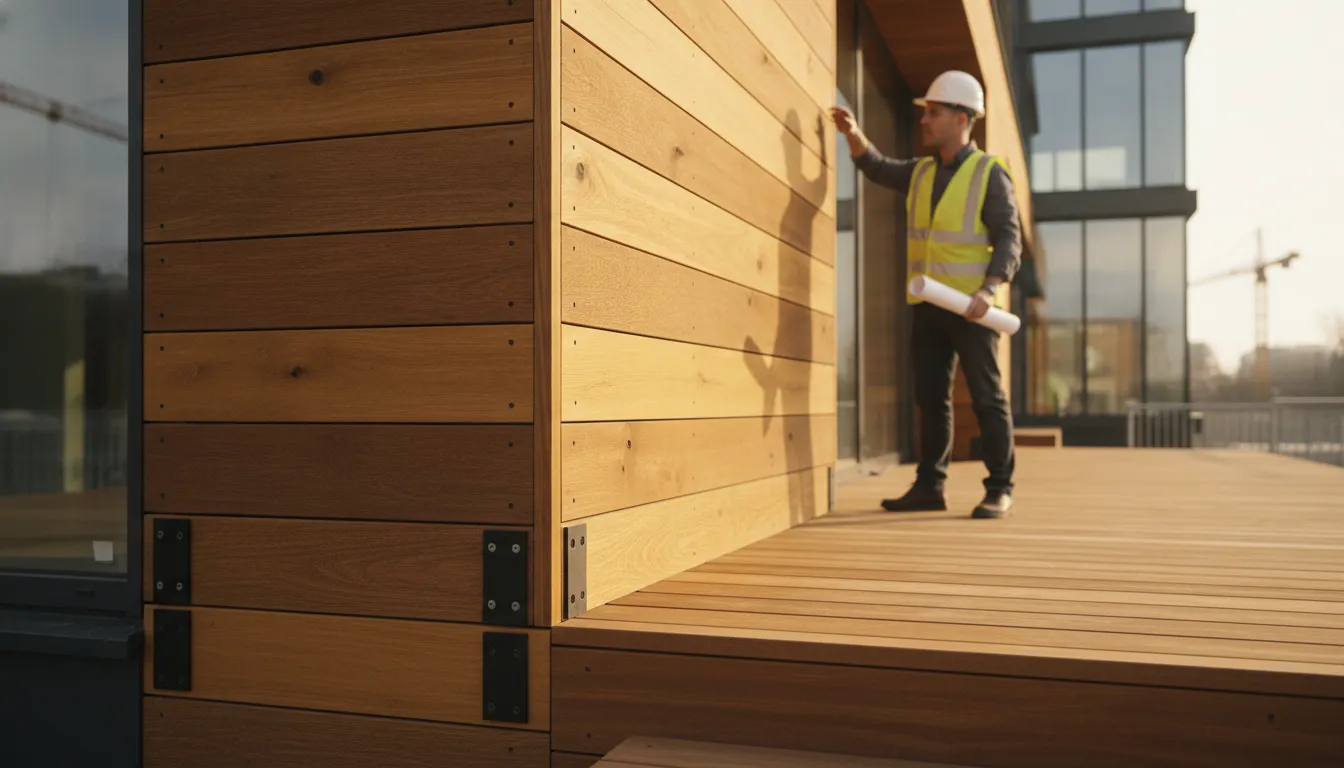
Exterior trade projects demand more than a familiar material choice. The right siding, decking, or trim specification should account for dimensional stability, durability classification, treatment method, maintenance planning, and documentation that supports the project team.
For many exterior applications, thermally modified wood vs pressure treated compares a documented, chemical-free modification process with a preservative treatment system.
The better fit depends on the project's performance, appearance, fire-rating, and procurement requirements.
American Thermo Wood manufactures Thermo Pine and Thermo Oak for trade applications, including siding, decking, and trim. Its 2nd Generation Hydrolysis process uses heat and pressure only, while the products are listed as Class 1 durability products. Review the full thermally modified wood comparison guide alongside project specifications, warranty requirements, and installation details before selecting a material.
For project-specific product guidance, start by understanding what pressure-treated lumber is and how its manufacturing process affects the comparison.
What Is Pressure-Treated Lumber and How Is It Made?
Pressure-treated lumber is conventional wood that has been processed to help it perform in conditions where moisture exposure and ground contact can accelerate deterioration. The treatment is applied after the lumber is manufactured into boards, posts, or other stock. For exterior siding, decking, and trim projects, the relevant question is not simply whether a board is labeled treated. The specification must show whether the product is appropriate for the exposure, profile, and installation details of the assembly.
In a typical pressure-treatment process, lumber is placed in an industrial vessel. A vacuum helps draw air from portions of the wood structure, treatment fluid is introduced, and pressure is applied to drive that fluid deeper into the material. The exact formulation and retention level vary by product and intended use, and those details affect handling, corrosion considerations, finishing, and disposal requirements. Builders should rely on the supplier's current documentation rather than assume that every treated board has the same properties.
For a professional material comparison, verify these items before approving pressure-treated lumber for a project:
- Use category: Confirm the documented exposure classification, such as above-ground exterior use or another specified condition.
- End use: Check that the product is intended for the actual application, whether decking, siding, trim, or supporting components.
- Retention and treatment documentation: Review the treating plant's certification, product data, and any required retention information.
- Installation compatibility: Confirm fastener, connector, flashing, coating, ventilation, and clearance requirements with the manufacturer.
- Project compliance: Coordinate fire, moisture-management, profile, and code documentation with the architect, building official, and installation specifications.
These checks establish a defensible baseline, but they do not answer every lifecycle question. Boards that meet a treatment category can still require careful detailing, acclimation, installation, and maintenance planning. The comparison should also account for dimensional movement, appearance, chemical-treatment requirements, warranty terms, and the documentation available to the design and construction team.
American Thermo Wood offers a different material approach for exterior applications. Its Thermo Pine and Thermo Oak siding, decking, and trim are modified with heat and pressure rather than preservative chemicals. The 2nd Generation Hydrolysis process, product-specific durability data, and installation resources should be reviewed alongside the pressure-treatment documentation when selecting materials for a project.
What Is Thermally Modified Wood vs Pressure Treated Lumber?
Thermal modification changes the wood itself through a controlled heat-and-pressure process. It is not a surface coating or a preservative added after milling. American Thermo Wood uses a proprietary 2nd Generation Hydrolysis process that applies heat and pressure only, at approximately 338 F and 174 PSI. The process uses no chemicals, preservatives, or toxic treatments. For contractors, architects, and distributors, that distinction matters because the material specification begins with how the wood is modified, not simply how it is marketed.
How thermally modified wood vs pressure treated choices differ
Pressure treatment and thermal modification address exterior material performance through different approaches. A pressure-treated specification depends on a preservative treatment system, while American Thermo Wood's Gen 2 process modifies the wood using heat and pressure without adding preservatives. Those are different manufacturing pathways, so project teams should evaluate the product documentation, intended exposure, profile, fire requirements, and warranty rather than treating the two labels as interchangeable.
American Thermo Wood states that its Gen 2 process delivers Class 1 performance, compared with Class 2 for Gen 1 processes. Its Thermo Pine and Thermo Oak siding, decking, and trim are listed as Class 1 durability products, with an expected lifetime of more than 25 years. These are product-specific claims that should be reviewed with the applicable technical documentation and project requirements. The company's 2nd Generation Hydrolysis process resource explains the process and its stated performance distinctions in more detail.
The wood species and finished application still matter. Thermo Pine is made from Southern Yellow Pine, primarily Longleaf Pine, while Thermo Oak is made from Northern Red Oak. Both are available across siding, decking, and trim applications. Thermo Pine and Thermo Oak siding use Nickel Gap tongue-and-groove profiles, while decking is available in Double Groove or S4S profiles at 5/4 x 6. This gives a specification team a way to select the species and profile that fit the design, installation, and distribution requirements instead of choosing a treatment method in isolation.
For a broader project review, compare the modification process with the product's durability classification, dimensional data, fire rating, and warranty. American Thermo Wood provides a 20-year transferable warranty, but the warranty terms should be reviewed before specification. The useful question is not whether one process is universally better. It is whether the documented characteristics of Thermo Pine or Thermo Oak align with the exterior assembly and the risk criteria for the project.
Durability Comparison: Class 1 Thermally Modified vs ACQ Pressure Treated
For trade projects, the useful question is not simply which material is labeled treated. It is whether the specified product has documented performance for the exposure, assembly, and application. American Thermo Wood lists its Thermo Pine and Thermo Oak siding, decking, and trim as Class 1 durability products, with an expected lifetime of more than 25 years. Review the Class 1 durability documentation alongside the project specification.
Specification comparison for thermally modified wood vs pressure treated lumber
| Selection criterion | American Thermo Wood Thermo Pine and Thermo Oak | ACQ pressure-treated lumber baseline |
|---|---|---|
| Durability classification | Listed as Class 1 durability, with an expected lifetime exceeding 25 years. | Verify the specific product's durability classification, exposure rating, and intended application from its manufacturer documentation. |
| Treatment basis | Gen 2 Hydrolysis uses heat and pressure only, approximately 338 F and 174 PSI, without chemicals or preservatives. | Verify the treatment standard, retention information, use category, and handling requirements for the selected ACQ product. |
| Product fit | Available as Thermo Pine and Thermo Oak siding, decking, and trim for specification-led exterior work. | Verify the grade, profile, dimensions, and suitability for the intended siding, decking, or trim assembly. |
| Warranty and documentation | Backed by a 20-year transferable warranty. Technical data and project-specific requirements should be reviewed before ordering. | Verify warranty terms, installation instructions, and documentation directly with the lumber supplier or manufacturer. |
The standards named in a submittal should match the claim being made. EN 73+113 and EN 84+113 are relevant to durability testing documentation and assessment of resistance to biological attack. EN 317 addresses thickness swelling, not a general service-life promise. For fire performance, ASTM E84 is the appropriate reference when the tested assembly and rating are actually identified. American Thermo Wood reports standard Class C siding and Class B decking and trim, with Class A available through FR treatment where offered. Confirm the required rating for the project rather than transferring a rating between products.
This framework helps contractors, architects, and distributors compare documented performance instead of assuming that every pressure-treated product has the same result. Thermo Pine, made primarily from Longleaf Southern Yellow Pine, and Thermo Oak, made from Northern Red Oak, should be evaluated against the project's exposure, detailing, fire requirements, and procurement documents. Use the technical data resources to assemble the submittal package and identify any remaining items that require manufacturer verification.
Chemical Safety: Why Chemical-Free Matters for Exterior Projects
For architects, contractors, and distributors, chemical-free processing is a specification consideration rather than a fear-based sales argument. The relevant question in a thermally modified wood vs pressure treated comparison is how each material is produced, what documentation the project requires, and whether the selected product aligns with the design and procurement brief.
American Thermo Wood's Gen 2 Hydrolysis process modifies wood using heat and pressure only, approximately 338 F and 174 PSI. The process uses no chemicals, preservatives, or toxic treatments. That distinction gives specifiers a clear manufacturing description to carry into product schedules, submittals, and material discussions. It does not replace project-specific code review or the need to evaluate the complete assembly, finish system, fasteners, and installation details.
Read the details of the 2nd Generation Hydrolysis process to review how the treatment is applied and how American Thermo Wood describes its performance objectives. The same resource identifies the Gen 2 process as providing Class 1 performance compared with the company's stated Class 2 benchmark for Gen 1 processes. Those classifications should be reviewed alongside the project's required test data and specification criteria.
What chemical-free means for project documentation
Chemical-free does not mean a project can skip technical verification. Architects and designers still need the applicable durability, fire, moisture, and installation information. Contractors need material that fits the approved details and field sequence. Distributors need product documentation that helps their customers compare options without overstating what the material does.
American Thermo Wood applies this process to Thermo Pine and Thermo Oak siding, decking, and trim. Thermo Pine is made from Southern Yellow Pine, while Thermo Oak is made from Northern Red Oak. Both give trade buyers a documented alternative for exterior wood specifications when the brief calls for thermally modified wood produced without chemical preservatives.
The practical decision is therefore not whether one material should be described with alarm. It is whether the manufacturing method, supporting data, product profile, and project requirements are aligned before procurement and installation begin.
Dimensional Stability, Maintenance, and Lifecycle Cost Comparison
For contractors, architects, and distributors, a material comparison should account for more than the purchase order. The useful question is how the assembly behaves after installation, how maintenance is planned, and where movement or moisture can create rework. That is the practical lens for evaluating thermally modified wood vs pressure treated on an exterior project.
American Thermo Wood reports that Thermo Pine siding has 1.5% tangential dimensional stability and an equilibrium moisture content of 5.9% at 65% relative humidity and 70 F. Those figures describe specified test conditions, not a universal field guarantee, but they give a design and installation team measurable data for reviewing movement-sensitive details. The complete technical data and dimensional stability information should be reviewed alongside the project conditions.
Plan maintenance around exposure and finish decisions
Lifecycle planning still requires attention to exposure, drainage, clearances, fastening, ventilation, and the selected finish. A stable substrate can help a crew manage joints, reveals, and alignment, but it does not remove the need for correct installation. For siding, Thermo Pine and Thermo Oak are available in Nickel Gap tongue-and-groove profiles. For decking, the available Double Groove and S4S profiles should be evaluated against the specified layout and site conditions.
Maintenance reviews should document the finish system, inspect vulnerable transitions, and distinguish appearance maintenance from structural performance. This gives owners and facility teams a repeatable schedule rather than an assumption that any wood product is maintenance-free. It also helps contractors identify whether a callback relates to installation, water management, coating appearance, or material movement.
Evaluate risk, warranty, and rework together
Do not assign a lifecycle cost based on an unsupported price comparison. Instead, compare the items that affect total project value: expected service life, documented dimensional behavior, labor for inspections and refinishing, material waste, access requirements, callback exposure, and warranty support. American Thermo Wood identifies Thermo Pine and Thermo Oak siding, decking, and trim as Class 1 durability products with an expected lifetime of more than 25 years. Review the Class 1 durability documentation before making a project-specific decision.
The company also offers a 20-year transferable warranty. Teams should read the warranty terms, confirm the application fits its requirements, and retain installation and maintenance records. That documentation matters to trade buyers managing handoffs, distributors supporting contractors, and owners evaluating long-term risk.
Which Should You Specify? A Decision Framework for Builders and Architects
The right material choice depends on the project brief, not on a generic label. When evaluating thermally modified wood vs pressure treated, compare documented performance, detailing requirements, procurement, and the level of support your team needs after installation. For a broader project review, use the thermally modified wood comparison guide. Use the following sequence to keep the decision aligned with the building's exposure, appearance, and specification requirements.
- Start with the project fit. Identify whether the material will be used for siding, decking, trim, or more than one application. American Thermo Wood offers Thermo Pine and Thermo Oak in all three categories. Thermo Pine is made from Southern Yellow Pine, primarily Longleaf Pine, while Thermo Oak is made from Northern Red Oak. Confirm the species, grade, profile, and appearance required by the drawings before comparing alternatives.
- Request the documentation package. Architects and estimators should review the technical data, relevant test information, installation guidance, and warranty terms. Look for evidence that supports the claims important to the project, including durability, dimensional performance, and fire testing. Do not substitute a broad product category description for project-specific documentation.
- Check durability and dimensional stability. Thermo Pine and Thermo Oak siding, decking, and trim are listed as Class 1 durability products, with an expected lifetime of more than 25 years. The manufacturer reports 1.5% tangential dimensional stability for Thermo Pine siding and an equilibrium moisture content of 5.9% under specified laboratory conditions. Review the Class 1 durability information alongside the exposure and detailing requirements for the project.
- Match fire performance to the assembly. Confirm the rating required by the wall, deck, or trim assembly and by the authority having jurisdiction. American Thermo Wood identifies standard Class C fire performance for siding and Class B for decking and trim. Class A is available with FR treatment where offered. Treat the rating as a specification checkpoint, not an assumption based on species alone.
- Confirm profiles and installation details. Thermo Pine and Thermo Oak siding use Nickel Gap tongue-and-groove profiles. Decking is available in Double Groove or S4S at 5/4 x 6. Coordinate fastening, ventilation, end-grain protection, spacing, and substrate details with the applicable installation guidance. This step is where field workability and callback risk become practical design considerations.
- Verify distribution, warranty, and project support. American Thermo Wood distributes through partners across North America, so align the specification with the project's procurement path rather than assuming direct retail fulfillment. Review the 20-year transferable warranty, then confirm who will support submittals, installation questions, and product selection. If the documentation, profile, fire rating, and distribution plan all fit, Thermo Pine or Thermo Oak can be evaluated on the same disciplined basis as any exterior material specification.
Frequently Asked Questions
What is thermally treated?
Thermally treated wood is real wood modified with controlled heat and pressure to improve performance without chemical preservatives. American Thermo Wood uses its 2nd Generation Hydrolysis process at approximately 338 F and 174 PSI. The process produces Thermo Pine and Thermo Oak for siding, decking, and trim.
How should contractors compare thermally modified wood vs pressure treated for an exterior project?
Compare the materials against the project specification, not a generic product label. Review documented durability, dimensional stability, moisture conditions, fire requirements, profile availability, installation details, warranty terms, and procurement support. American Thermo Wood identifies its Thermo Pine and Thermo Oak lines as Class 1 durability products with an expected lifetime above 25 years. While pressure-treated specifications must be evaluated from the specific product documentation.
Is thermally modified wood stable enough for siding and decking?
American Thermo Wood reports 1.5% tangential dimensional stability for Thermo Pine siding, with an equilibrium moisture content of 5.9% at 65% relative humidity and 70 F. The project team should still follow the applicable installation and acclimation requirements for the selected siding or decking profile.
What products can a trade buyer specify from American Thermo Wood?
Trade buyers can specify Thermo Pine or Thermo Oak in siding, decking, and trim. Thermo Pine is made from Southern Yellow Pine, primarily Longleaf Pine, while Thermo Oak is made from Northern Red Oak. Siding is available in Nickel Gap tongue-and-groove profiles, and decking is available in Double Groove or S4S profiles at 5/4 x 6.
What warranty support is available?
American Thermo Wood offers a 20-year transferable warranty. Architects, contractors, and distributors should review the warranty document for its complete terms and confirm that the selected product and installation meet the applicable requirements.
Ready to Review Your Thermo Pine or Thermo Oak Project?
A technical review can help contractors, architects, and distributors match the right siding, decking, or trim profile to the project requirements. Discuss material selection, specifications, and application details for an exterior project with the American Thermo Wood team. Free Project Consultation is the next step. You can also call 833.533.3350 to get started.
Planning a project in Utah?
Talk with Red Rooster Construction about your build, remodel, or outdoor space.
Request a Quote